Metals Price Volatility: Implications for Inventory, Lending and Collateral Management
This article was originally published in the November 2026 issue of The Secured Lender.
A new set of geopolitical and economic forces is reshaping the metals markets. Over the last two years, the price of aluminum has nearly doubled for U.S. buyers, while steel and copper prices have jumped between 47% and 68%, depending on the grade. For metals companies and their lenders, the challenge is no longer simply managing higher costs. It is navigating an environment in which inventory values, working capital needs and collateral coverage can change rapidly.
These dynamics have strained liquidity for metals processors, distributors, manufacturers and scrap dealers while increasing the risk that their inventory could suffer sudden changes in value. This environment also heightens risk for lenders as rapid shifts in metals prices can significantly affect the value of inventory serving as collateral.
Companies are responding by focusing on turnover, inventory supply on hand, and in some cases employing derivatives-based hedging strategies. For their part, lenders are placing greater emphasis on maintaining accurate, up-to-date valuations of company inventories.
Figure 1: Rising Metals Prices
Aluminum, copper and steel coil prices have risen dramatically over the last two years.
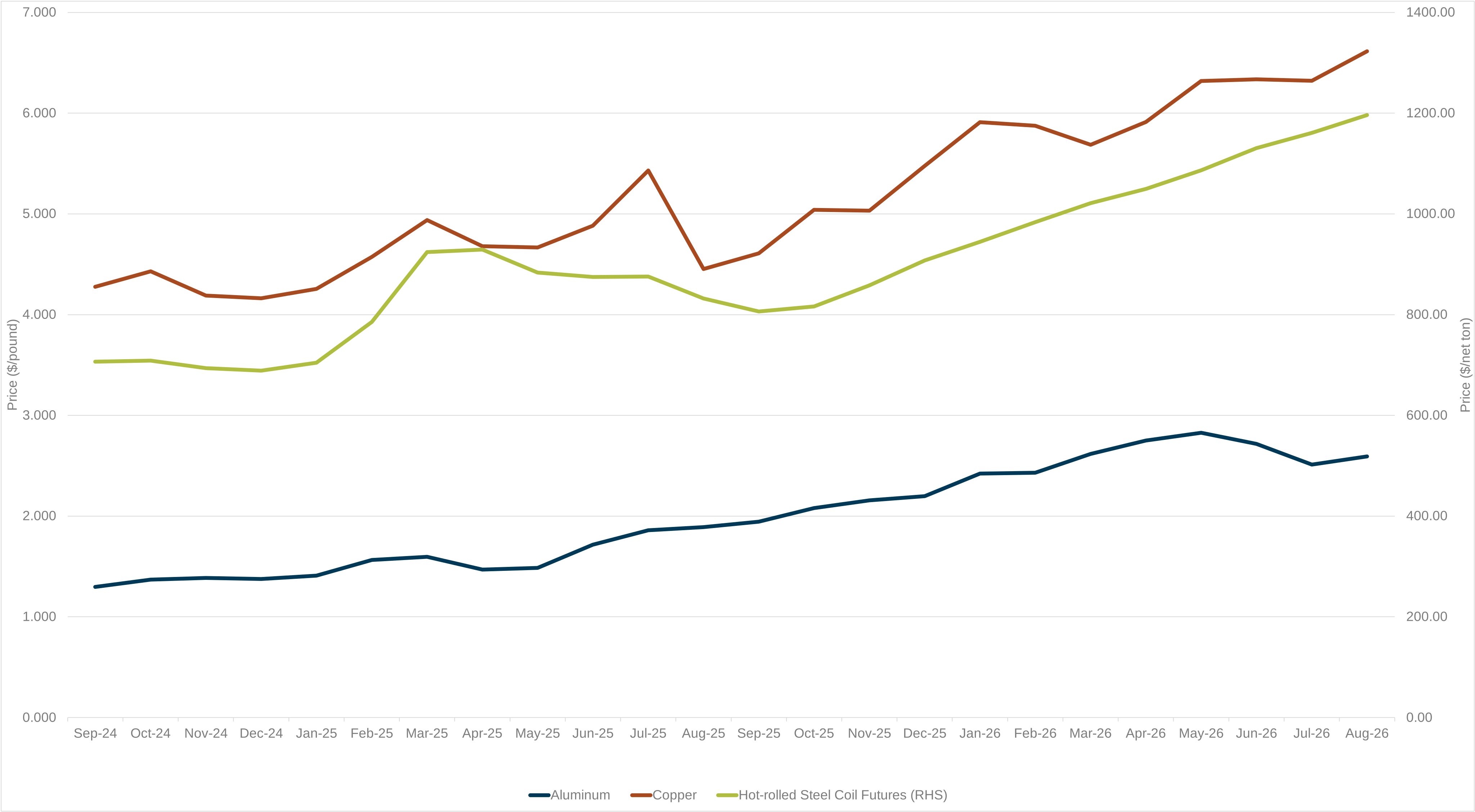
Source: Tower Extrusion, aluminum monthly Midwest average; MacroTrends, copper monthly price; Investing.com, hot-rolled steel coil futures monthly price. Data as of August 31, 2026.
Tracing the Causes of Higher Metal Prices
Cyclical price shifts are intrinsic to the metals business. But many of the factors driving today’s price increases and volatility extend beyond traditional supply-and-demand dynamics. Conflicts in the Middle East and Eastern Europe have disrupted supply chains, while shifting U.S. tariffs have raised the costs of material from Canada and other trading partners. Higher energy prices have also raised production and shipping costs. At the same time, the AI-driven data center buildout has boosted demand for key materials. Together, these factors have led to greater investment flows in exchange-traded metals.
That larger picture affects each metal in different ways.
Aluminum
Aluminum has experienced intense supply-side pressure as the war in Iran and the resulting disruption in the Strait of Hormuz have slowed the global movement of commodities. While public attention has focused on oil, aluminum is similarly vulnerable to supply shocks in the Middle East. The Persian Gulf region produces approximately 11% of the world’s aluminum; about 80% of that supply is exported, making the global market particularly vulnerable to shipping closures.
As disruptions in the Strait have slowed metals distribution, producers have reduced output. Gulf exports are running at around 60% of pre-war levels. And because aluminum production is energy-intensive, higher energy prices are adding further pressure to costs.
All these factors raise the cost of aluminum globally, as reflected by its price on the London Metals Exchange (LME). U.S. buyers face an additional cost layer: U.S. purchasers of aluminum pay the Midwest Transaction Price (MWTP), which includes a premium to account for tariffs, freight and other expenses. That premium has increased by a factor of more than five in the last two years, rising from $0.19 per pound in September 2024 to $1.12 per pound in August 2026.1 As a result, while LME aluminum prices rose 33% over the past two years, prices for U.S. buyers climbed 99%.
Figure 2: A Widening Gap in the Price of Aluminum in the U.S.
U.S. aluminum buyers have faced a growing cost premium even as the metal’s global price has risen.
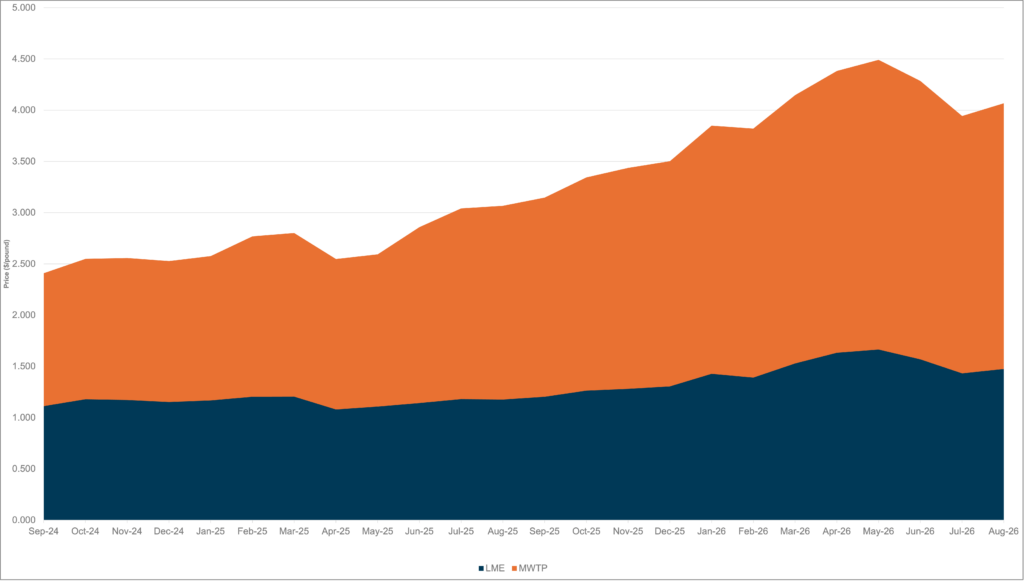 Source: Tower Extrusion, aluminum monthly Midwest average; westmetall, aluminum LME monthly price. Data as of August 31, 2026.
Copper
A key driver of copper’s price increase is the ongoing AI buildout. Because the material is critical to nearly every part of data infrastructure, rising investment in semiconductors, chip manufacturing facilities and data centers has intensified demand for copper, along with other metals. Copper, which traditionally has been used as an inflation hedge, may also be especially sensitive to investment flows during periods of high inflation.
Steel
Steel, particularly hot-rolled coil, also faces distinct pressures. Steel tariffs imposed under Section 232 of the Trade Expansion Act have curtailed roughly 50% of the imports of the lower-cost coil entering the U.S. market. Service centers have pulled back on inventory as well, both because of lower supply and to manage risks related to price volatility. Spot market availability is low, leading mills to prioritize contract customers over single orders.
Metals as an Inflation Hedge Adds to the Demand
Aluminum, copper and steel are actively traded on exchanges, where investors commonly use them as a hedge against inflation and for other financial purposes. The macroeconomic environment has led to increased demand for metals as investments, adding to the mix of factors driving prices higher.
This combination of structural and cyclical forces is creating greater uncertainty, forcing industry participants to rethink how they manage current risks.
How Metals Companies Can Navigate Today’s Challenges
Higher prices can strain operations for companies that purchase metal. Buyers may need more vendor credit, greater working capital or other sources of liquidity. And they may be intensely wary of over-buying near a peak.
Many companies are navigating this environment by exercising greater discipline around inventory. They are maintaining conservative inventory levels, basing purchase decisions on realistic demand and resisting the temptation to build supply in anticipation of further price increases. Aggressive inventory management can take a variety of forms, depending on the business. Some scrap processors and hot-rolled-coil manufacturers turn inventory as much as 14 times a year, while suppliers carrying a diverse product range may turn inventory just once annually. In each case, the goal is to minimize the impact of price volatility on inventory values.
Companies also are diversifying suppliers, helping insulate against disruption in purchases from any one provider, and renegotiating contracts, which can provide greater clarity for buyers and sellers alike. Larger companies can employ derivatives-based hedging tools to manage commodity exposure.
Strategies for Lenders
Lenders to metals companies are strengthening oversight, monitoring turnover more closely and conducting appraisals more frequently, in many cases moving from annual to quarterly reviews.
Collateral values may rise less than metals prices depending on market dynamics. Employing lower-of-cost-or-market (LCM) analysis helps lenders account for that fact. Considering not just market price and inventory on hand but also turnover speed, the amount that needs to be moved and buyer demand can help lenders develop a clearer picture of the realizable value of the collateral they are lending against.
There is little evidence to suggest that pressures on metal prices will ease anytime soon. For both metals companies and their lenders, an even more disciplined, attentive approach to inventory, turnover and collateral monitoring may become the new normal.
- Platts Market Data, as of August 31, 2026.